

The Father of Ketones and the Value of Exogenous Ketone Esters
I've talked about ketones and ketone esters for many years, and I've now come to a place where I really have to take a more direct stand on how they’ve been marketed to the wider public, and in particular, to providers who may not have had the opportunity to review a product’s scientific background. I’ve addressed this topic in a recent Rabbit Hole - Ep. 75 (2.16.26) and believe that it warrants further discussion. Specifically, I am concerned about some of the mislead marketing related to ketone ester supplements, which continue to draw attention for the pleiotropic and performance-enhancing effects based on substantive research.
It’s become quite evident that some of the significant details of the original research that demonstrate and explain the cellular mechanisms involved in ketone ester products have been lost in the frenzy of product development and marketing. And although there is overwhelming evidence showing how the state of ketosis can improve cellular health, enhance physical performance, and improve cognition, among other positive effects, it’s important that we as providers are aware of the molecular mechanisms that enable exogenous ketone esters to function so effectively. In short, I don't like it when I see science misrepresented so that certain people can profit.
It’s for this reason that I am taking this opportunity to return to the original research of Dr. Richard Veech, a medical scientists who has influenced me enormously.I refer to him as the godfather of ketones; indeed, Veech spent a great part of his career studying lipids and ketones, which ultimately led him to develop a ketone monoester while he was at the NIH.
Specifically, in the early 1990s and early aughts Richard Veech, MD, PhD, along with Dr. Kieran Clarke (University of Oxford), developed the (R)‐3‐hydroxybutyl (R)‐3‐hydroxybutyrate ketone monoester (KME) for oral consumption in humans. Over the next decade, they tested the ketone monoester extensively to establish its efficacy and safety for both animals and humans. Veech’s KME has the capacity to be ingested rapidly (<30 min after ingestion), thereby elevating circulating βHB concentrations of approximately 2–6 mm, which is similar to levels observed with several days of fasting.
The Importance of Energy Dynamics: It’s All About Maintaining Efficiency

As I often note, improving physiological and cognitive functioning is rooted in improving cellular efficiency. Cellular efficiency stems from how well the system works to make ATP and how well the system can maintain control of redox. (Keep in mind that redox is all about keeping a system efficient where the oxidative stress and the reductive stresses are kept at equilibrium.) And yet the cell is always challenged to maintain its efficiency. So say we have a cell that is upregulating itself to adapt to a stressor – whether a mental stressor, environmental stressor, or exercise –under such conditions, the cell is more than likely going to try and adapt to improve its ATP and NAD+ production, and in doing so, choose from available substrates, such as glucose, fatty acids, and amino acids. In order to remain efficient, the cell needs to stay flexible in its choice and use of substrate in order to best support the mitochondria. And it’s this flexibility that defines the cell’s efficiency.
The cell depends on glycolysis in the cytoplasm as well as the TCA cycle (Krebs cycle), which occurs inside the mitochondrial matrix for sufficient ATP and NAD+. Of note, glycolysis and the TCA cycle are metabolically interdependent because both rely on a continuous balance between NAD⁺ and NADH. During glycolysis, NAD⁺ is reduced to NADH as glucose is converted into pyruvate. Pyruvate then enters the mitochondria and fuels the TCA cycle, which generates additional NADH as it oxidizes acetyl-CoA. These reduced electron carriers deliver their electrons to the electron transport chain, where NADH is oxidized back to NAD⁺. This regeneration of NAD⁺ is essential, because both glycolysis and the TCA cycle require NAD⁺ to continue operating. In this way, oxidative phosphorylation not only produces ATP but also maintains the redox balance that allows upstream metabolic pathways to function. If oxygen is limited and electron transport slows, NAD⁺ regeneration falls, leading to a buildup of NADH and a slowing of both glycolysis and the TCA cycle unless alternative pathways, such as lactate production, restore NAD⁺ availability.
In addition to glycolysis and the TCA cycle, cells can also generate ATP through fatty acid β-oxidation. When fatty acids are mobilized and transported into the mitochondria via the carnitine shuttle, they undergo sequential cycles of β-oxidation that cleave two-carbon acetyl-CoA units from the fatty acyl chain. Each cycle produces NADH and FADH₂, which carry high-energy electrons to the electron transport chain. The acetyl-CoA generated then enters the TCA cycle, producing additional NADH and FADH₂. As these reduced cofactors donate electrons to the electron transport chain, they are oxidized back to NAD⁺ and FAD, regenerating the electron acceptors required for continued metabolic flux while driving proton pumping and ATP synthesis through oxidative phosphorylation.
Under the influence of a stressor, the cell is pushed to adapt, and if fat such as a ketone ester is available it has a better chance of remaining flexible and efficient. This drive for efficiency is often undermined if the oxidative state of the cell changes either by overconsumption of food or the development of insulin resistance, for example, that affects the mitochondria and causes it to lose its flexibility. Such factors as the mitochondria being forced to use only glucose; or it's forced to use more protein; or the cell has become compromised in its ability to break down protein into amino acids to make energy. Regardless of the immediate cause or the metabolic factors involved, the mitochondria loses its flexibility, and overall cellular efficiency is weakened.
Keep in mind, too, that cells, tissues and organs such as the heart, the brain, muscle, the immune cell, or the liver, all have different demands for energy, which also put pressure on the cell’s ability to stay efficient.
Because fatty acids are highly reduced molecules, their oxidation yields substantially more NADH, FADH₂, and ultimately ATP per molecule than glucose, making fatty acid oxidation a highly efficient pathway for sustaining cellular energy production when oxygen is available. When the cell can choose fatty acids as substrates, and increase the production of FADH2, it can be used right away in cytochrome two and add to this efficiency of producing increased ATP and NAD+.
And this is where ketone esters come into play.
Where Ketone Esters Come into Play
As we know, ketosis is characterized by a state of elevated blood ketones, often measured by assessing the concentration of blood β‐hydroxybutyrate (β‐OHB), which is the most abundant and stable ketone body in circulation. Ketone bodies are produced endogenously from free fatty acids by the liver during times of limited glucose availability (e.g., starvation, carbohydrate restriction) and serve as an alternative fuel source for the brain and peripheral tissues.
As supplements, ketone esters are exogenous ketones designed to raise blood ketone levels (specifically beta-hydroxybutyrate) directly, without requiring the liver to break down fats. When supplied to the cell, in particular the mitochondria, they act like a super food, providing the cell with a powerful source of energy.
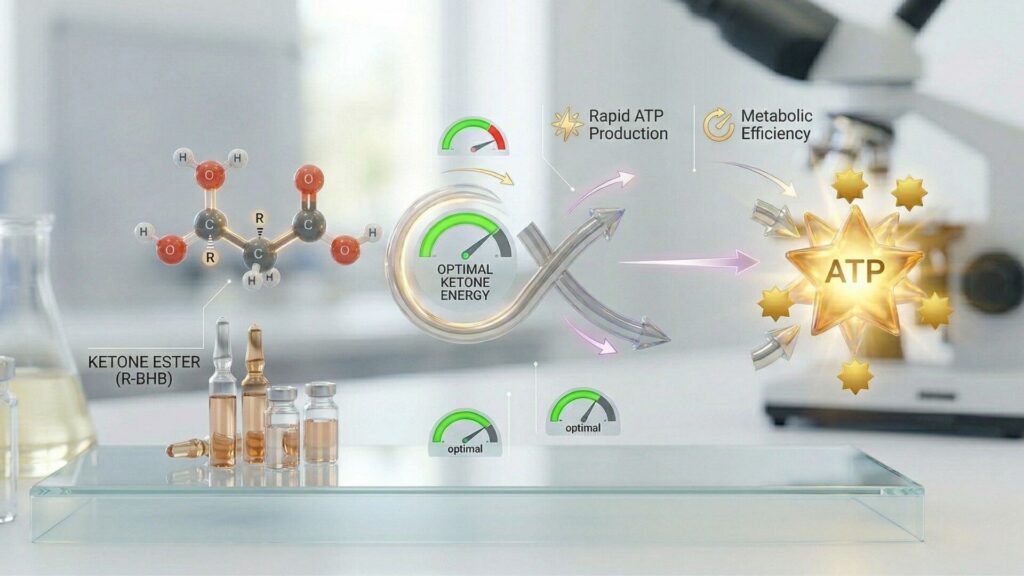
Specifically, ingestion of exogenous ketone esters shifts cellular energy metabolism by providing circulating ketone bodies as an immediate oxidative fuel. Further, ketones are known to improve the efficiency of energy production, in particular that of ATP and NAD+, which is then converted to NADH. After absorption, ketone esters are rapidly converted in the liver or bloodstream to BHB, which travels to peripheral tissues (such as the brain, muscle, or heart). Inside cells, BHB is transported into mitochondria and oxidized back to acetoacetate, generating NADH in the process. Acetoacetate is then converted to acetoacetyl-CoA and subsequently to two molecules of acetyl-CoA, which enter the TCA cycle. This increases delivery of reducing equivalents (NADH and FADH₂) to the electron transport chain, enhancing oxidative phosphorylation and ATP production when oxygen is available.
Metabolically, several shifts occur:
- Elevated ketones suppress glucose utilization and lower hepatic glucose output.
- Because ketones provide acetyl-CoA directly, the need for β-oxidation decreases.
- BHB oxidation increases mitochondrial NADH production, while cytosolic redox state may shift depending on transport and shuttle dynamics.
- Ketone oxidation can produce slightly more ATP per unit of oxygen consumed compared with fatty acids, which may be advantageous in tissues like the heart and brain.
Quite simply, exogenous ketones act as an alternative substrate that can elevate ATP production through mitochondrial pathways while modulating substrate competition among glucose, fatty acids, and ketones. Ketone esters turn off the mitochondria’s call for cytochrome 2 for FADH; it’s as if the mitochondria recognizes this “super food” that can rev up its electron transport chain, improve its proton motive forces, and do it without producing a high amount of reactive oxygen species.Indeed, ketone esters do an incredible job with redox. They have the most significant effect on improving redox so efficiently that it can rev up that proton motive force and make more ATP and NAD+ through the electron transport chain as compared to glucose, proteins, and fatty acids, all while not creating a redox burden for a specific tissue or organ.
Ketone esters also have an additional capability of oxidizing CoQ, coenzyme Q, which has the capability of slowing down the system of electron transport. When coenzyme Q is reduced, it can only take so many electrons, and that increases what's called the redox span, which allows a smoother, faster flow of electrons and production of ATP and NAD+ quality. This increased redox span creates less redox burden, and now you've got this wonderful system of more efficient energy production that the cell sees as a true benefit.
In short, ketones are “optimal” not because they always replace glucose or fatty acids, but because under conditions of carbohydrate scarcity or metabolic stress they provide an efficient, oxygen-conscious, redox-supportive, and signaling-active fuel that integrates seamlessly into mitochondrial ATP generation.
Veech’s (R)‐3‐hydroxybutyl (R)‐3‐hydroxybutyrate ketone monoester (KME)
Veech essentially created an NIH approved exogenous ketone ester that combined beta hydroxybutyrate, which is a ketone, and, through covalent bonding, an ester bond with a thirteen butanediol, a precursor for beta hydroxybutyrate or a ketone. It’s both this combination and the specific mono ester bond that is the hallmark of Veech’s contribution to the vast potential value of exogenous ketone esters. Indeed, he led years of research and produced over seventy papers related to the pharmacokinetics and the stoichiometry of the ketone monoester. He also closely examined the process by which cells and tissues are able to absorb the ketone monoester, both in terms of timing and competition with other substrates. Significantly, it’s this ester that bonds the beta hydroxybutyrate to the thirteen butanediol that’s key to this molecule working appropriately.
Without this ester bond, an exogenous “dump” of beta hydroxybutyrate (i.e., the ketone itself) would be forced to compete with pyruvate, lactate, and potentially other molecules to get into the cell through these monocarboxylate transporters. And while there's always going to be competition to get into the cell, if suddenly you load the system with a beta hydroxybutyrate, you're going to get a lot of pooling of beta hydroxybutyrate. That pooling of beta hydroxybutyrate creates a problem with kinetics, as well as exacerbating the competition to get into the cell. Therefore, being able to monitor or control the timing and release of how this ketone operates becomes essential, and this is what Veech knew. He knew he had to figure out a process whereby a tissue or a specific cell would more than likely accept the exogenous beta hydroxybutyrate to use it efficiently to produce energy and ultimately improve redox.
Veech and his colleagues discovered that when beta hydroxybutyrate is combined with this thirteen butanediol, it slowly releases beta hydroxybutyrate in the vasculature through hydrolysis of the ester bond. This thermodynamic or pharmacologic release of the beta hydroxybutyrate is better tolerated by the specific cell and tissue because of the presence of the ester bond. And although it's still competing for that MCT transporter, the ketone is not pooling and it's not creating other issues of competition. Instead, it's being utilized more efficiently by the cell, whereby it can then produce NADH (through complex one) to oxidize coenzyme Q and improve electron transport flow, which in turn enables an increase in production of ATP and NAD+ with less reactive oxygen species. The result makes the overall system more efficient.
By itself, the esterified thirteen butanedio is similar to an aldehyde alcohol, and when ingested, will automatically be taken up and metabolized by the liver, which will have its own redox demands. However, if the ketone is esterified, then the thirteen butanediol is free and neutral. It's not going to be taken up by the liver and metabolized, but will instead be utilized later in the liver where it won't be a redox burden. In fact, this becomes an additional, compensatory way for the cell or tissue to utilize the beta hydroxybutyrate and ketones secondarily in peripheral areas of the cell or tissue, such as muscle or the brain.
Keep in mind, too, that when the cell is trying to optimize itself while also under constant pressure to make ATP, and is able to use beta oxidation (typically of fat) to remain efficient, there is a cost: the beta oxidation of fat reduces coenzyme Q. As a result, the beta oxidation of fat and reduced coenzyme Q will have an influence on the efficiency of that cell that otherwise could be utilizing the beta hydroxybutyrate as its primary energy source; now it's going to have a much harder time when it's utilized later in adjusting to further oxidize CoQ and to be used efficiently because the liver now has this burden of a significant redox hit from the thirteen butanediol and that affects the liver. (Remember the liver has many influences on mitochondria to make mitochondria more efficient.) So they play on each other here.
My point? We know, both through Veech’s original research and subsequent studies that beta hydroxybutyrate needs to be combined with thirteen butanediol through an ester bond in order to produce its positive energetic effects on the cell and tissues.
The Missing Link in Some Ketone Products on the Market

Without the thirteen butanediol, the beta hydroxybutyrate begins to pool, and because of competitive issues in pharmacokinetics, the ketone now has to fight to be absorbed and get into peripheral cells. As a result, the whole process of enabling the cells, tissues or peripheral areas like the muscle or brain to utilize the ketone will be delayed or perhaps not even absorbed.
Additionally, if the thirteen butanediol is free, it doesn’t go through this first pass process to be utilized later. Instead, it's immediately taken up by the liver; the liver then must go through another process of utilizing the thirteen butanediol, which creates its own redox burden on the liver. In both these cases, the cell has further lost the efficiencies because the beta hydroxybutyrate can’t get into the peripheral tissue, while at the same time hitting the liver with this big burden of thirteen butanediol that's creating a redox burden.
Interestingly, Veech’s studies also identified further negative effects of using thirteen butanediol by itself when it wasn't esterified: CNS depression. And while discussing this potential effect is beyond the scope of this article, I want to now draw your attention back to my original concern: the fact that many ketone ester products on the market today do not reflect the important combination of beta hydroxybutyrate and thirteen butanediol connected through an ester bond.
Many of these ketone ester products are missing this formula, and yet will often be presented as reflecting the Veech and others’ data and research. This is troubling from an ethical point of view; however it’s also an example of not only using established science inaccurately but also an indication of being perhaps scientifically illiterate when they refer to studies as support for products that don’t align with that research, and in this case, to the substantive research behind the ketone monoester (KME). Indeed, I've come across individuals at one of my conferences or masterminds, who unwittingly believe a product that they refer to as a “kinetic” as possessing the same value as the KME developed by Veech and Clarke.
My advice? Do your own homework and do your own research. It’s important that as a trusted SSRP provider that you know what you're using and why it's effective. And I hope this has helped you understand this issue a little bit better so you can make better decisions for yourself and your patients. As always, I welcome any comments to add to this discussion.
References:
- Egan B. The glucose-lowering effects of exogenous ketones: is there therapeutic potential? J Physiol. 2018 Apr 15;596(8):1317-1318. doi: 10.1113/JP275938. Epub 2018 Mar 24. PMID: 29473164; PMCID: PMC5899977.
- Falkenhain K, Islam H, Little JP. Exogenous ketone supplementation: an emerging tool for physiologists with potential as a metabolic therapy. Exp Physiol. 2023 Feb;108(2):177-187. doi:10.1113/EP090430. Epub 2022 Dec 19. PMID: 36533967; PMCID: PMC10103874.
- Murray AJ, Knight NS, Cole MA, Cochlin LE, Carter E, Tchabanenko K, Pichulik T, Gulston MK, Atherton HJ, Schroeder MA, Deacon RM, Kashiwaya Y, King MT, Pawlosky R, Rawlins JN, Tyler DJ, Griffin JL, Robertson J, Veech RL, Clarke K. Novel ketone diet enhances physical and cognitive performance. FASEB J. 2016 Dec;30(12):4021-4032. doi:10.1096/fj.201600773R. Epub 2016 Aug 15. PMID: 27528626; PMCID: PMC5102124.
- Stubbs BJ, Cox PJ, Evans RD, Santer P, Miller JJ, Faull OK, Magor-Elliott S, Hiyama S, Stirling M, Clarke K. On the Metabolism of Exogenous Ketones in Humans. Front Physiol. 2017 Oct 30;8:848. doi: 10.3389/fphys.2017.00848. PMID: 29163194; PMCID: PMC5670148.
- Veech, R. L. (2014). Ketone ester effects on metabolism and transcription. Journal of Lipid Research, 55(10), 2004–2006. https://doi.org/10.1194/jlr.R046292